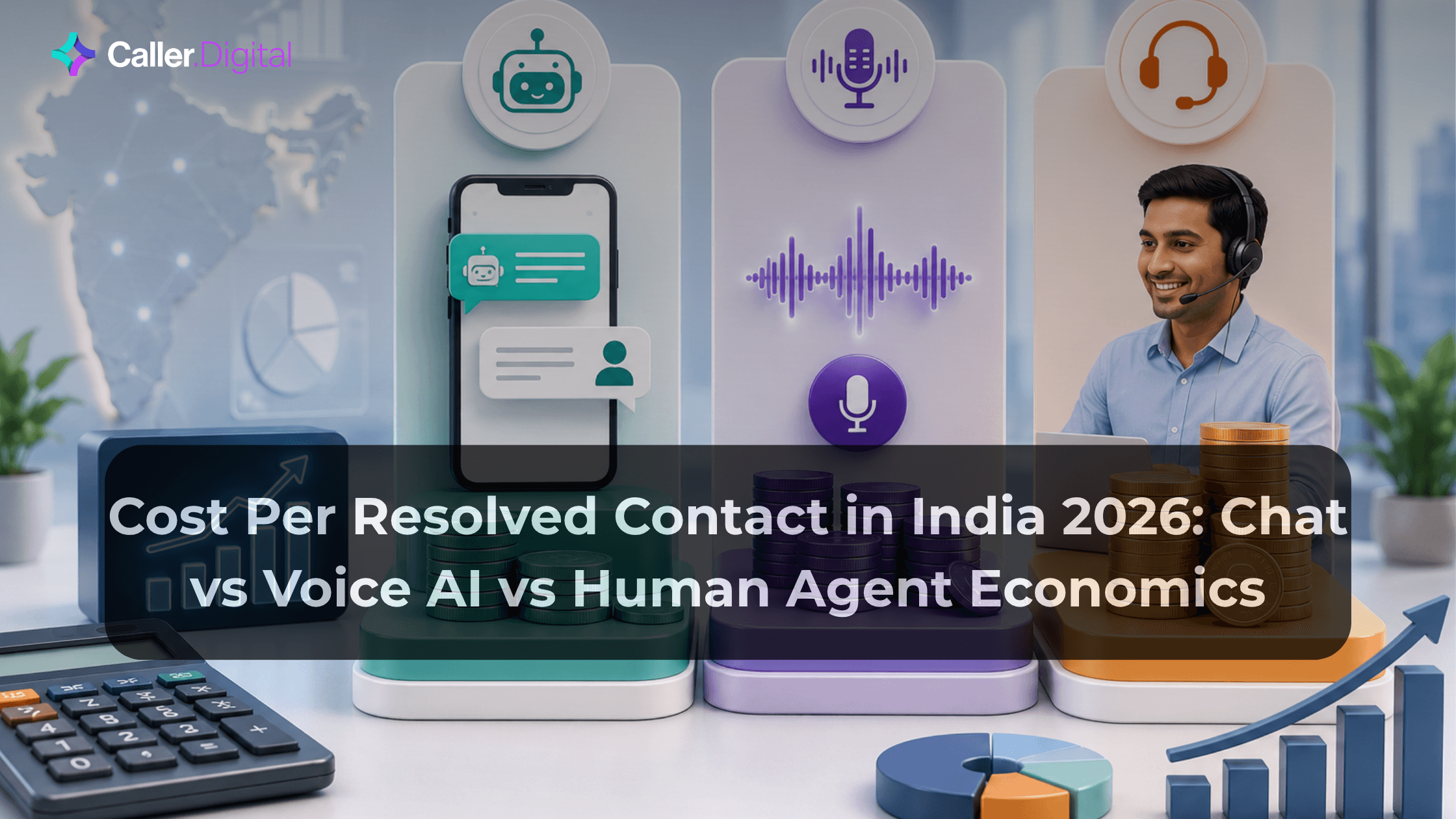
Cost Per Resolved Contact in India 2026: Chat vs Voice AI vs Human Agent Economics
The CFO has two quotes open on the same screen and no way to compare them. The first is from a voice AI platform, priced at ₹6.50 per minute. The second is from a global support AI vendor, priced at $0.99 per resolution. Her Head of CX has already picked a favourite. Her job is to work out which one is cheaper, and after forty minutes she has established only that the two numbers cannot be subtracted from each other.
She is asking the wrong question, but for the right reason. Nobody at the table has the number that would settle it, because nobody is measuring cost per resolved contact. They measure cost per minute, cost per seat, cost per message and cost per ticket, and all four of those can fall while the total support budget rises.
What this post argues
There is exactly one unit that lets you compare a voice AI platform, a chat AI platform, an Indian BPO and your in-house team: fully loaded cost per resolved contact, where "resolved" means the customer did not come back. Compute it properly and two things happen that surprise most Indian teams. First, global per-resolution pricing frequently costs more than an Indian human agent, because Indian labour is cheap and dollar-denominated AI is not. Second, cheapest-channel-first routing raises total cost on several intent classes, because a failed deflection costs more than never attempting it. This post gives you the model, the Indian input numbers, the routing policy that falls out of it, and the six modelling errors that make every vendor business case look better than reality.
Why the unit changed in 2026
Cost per minute was a sensible unit when the thing you bought was minutes. It stopped being sensible when part of the work started being done by something billed per resolution, per conversation, per token, or not at all.
Three shifts forced the change.
Per-resolution pricing arrived and does not convert cleanly. Intercom Fin charges $0.99 per resolution, Zendesk roughly $1.50, and Salesforce Agentforce $2.00 per conversation regardless of outcome. At roughly ₹88 to the dollar, that is ₹87, ₹132 and ₹176 respectively. Hold those numbers. They are the crux of the Indian argument later.
WhatsApp service messaging went to zero marginal cost. Meta's per-template pricing leaves customer-initiated service conversations free inside the 24-hour window, while India marketing templates run about ₹0.8631 and utility templates about ₹0.115 as of January 2026. A channel with a zero marginal message cost breaks any model built on cost per interaction.
The gap between deflection and resolution became measurable. Gartner finds AI deflects over 45% of queries while only around 14% reach genuine self-service resolution, and 2026 production benchmarks put enterprise median tier-1 deflection at 41.2% with the top quartile at 58.7%. Once you can see that gap, every cost model built on deflection is visibly wrong.
Building the number
Cost per resolved contact has five layers. Most business cases include two.
Layer 1: The attempt. What it costs to have the AI or the human try. For voice AI in India this is platform plus telephony, typically ₹5 to ₹9 per minute all in. For chat AI it is compute, typically ₹3 to ₹10 per conversation on an Indian or self-hosted stack, or ₹87 to ₹176 on a global per-resolution or per-conversation vendor.
Layer 2: The escalation. What the failures cost. If the AI resolves 60%, the other 40% still need a human, and that human is now handling a customer who has already spent four minutes failing. Escalated contacts run longer than cold ones, typically 15 to 30% longer, and almost nobody models this.
Layer 3: The repeat. The customer who was recorded as resolved and came back. This is the failed-deflection tax and it is the layer that separates honest models from vendor models.
Layer 4: The fixed floor. Quality assurance, supervision, workforce management, the helpdesk licence, integration maintenance. AI does not remove these. It adds integration maintenance.
Layer 5: Compliance and infrastructure. Recording storage, DLT registration and scrubbing for outbound, consent logging, data residency. Small per contact, non-zero in aggregate.
The formula, per 100 inbound contacts, avoids algebra and survives a board meeting:
Total cost = (100 × attempt cost)
           + (failures × escalated human cost)
           + (repeats × repeat human cost)
           + fixed allocation

Cost per resolved contact = Total cost / 100
The denominator is 100, not the number the AI resolved. Every contact has to end somewhere. Dividing by AI resolutions is the most common way a business case gets inflated by 40%.
Indian input numbers for 2026
| Input | Range | Notes |
|---|---|---|
| Human chat agent, fully loaded | ₹42,000–₹55,000/month | Chat process BPO salaries average around ₹35,375/month before overhead |
| Chat agent throughput | 13–17 contacts/hour | 3 concurrent chats, 8 min handle time, 75% occupancy |
| Cost per human chat contact | ₹25–₹45 | Outsourced India non-voice runs $4–$8/hour |
| Cost per human voice contact | ₹60–₹130 | Outsourced India voice runs $6–$14/hour, 5 min including wrap |
| Voice AI, per 3-minute call | ₹15–₹30 | Platform plus telephony, Indian rates |
| Chat AI, Indian or self-hosted | ₹3–₹10 per conversation | Compute plus retrieval |
| Chat AI, global per-resolution vendor | ₹87–₹176 per resolution | Fin, Zendesk, Agentforce converted at ₹88/$ |
| Chat AI resolution rate | 55–70% | Mature, with live system integration |
| Voice AI resolution rate | 45–60% | Tier-1 intents |
| Repeat contact rate after AI resolution | 8–15% | Against 4–6% after human resolution |
Salary and rate sources: Indian call centre outsourcing rates for 2026 and published Indian chat process compensation data. Treat all of these as starting priors and replace them with your own numbers by week three.
The failed-deflection tax
Here is the mechanism nobody prices.
Take 100 chat contacts. The AI attempts all of them at ₹6 each: ₹600. It resolves 60. The other 40 escalate to a human chat agent, and because they arrive pre-frustrated they cost ₹35 rather than ₹30: ₹1,400.
Now the part the dashboard hides. Of the 60 marked resolved, 12% come back within 72 hours. That is seven customers. They arrive on a different channel, usually the phone, and they cost ₹95 each because voice is expensive: ₹665.
| Line | Cost |
|---|---|
| 100 AI attempts at ₹6 | ₹600 |
| 40 escalations at ₹35 | ₹1,400 |
| 7 repeat contacts at ₹95 | ₹665 |
| Total for 100 contacts | ₹2,665 |
| Cost per resolved contact | ₹26.65 |
Compare against an all-human baseline: 100 contacts at ₹32, plus a 5% repeat rate at ₹95, gives ₹3,675, or ₹36.75 per resolved contact.
The AI saves 27%. Real, defensible, and roughly a third of what the vendor deck claimed, because the deck stopped after the first line.
Now change one input. Move the repeat rate from 12% to 22%, which is what happens when the bot has retrieval but no live system access and answers policy questions instead of solving problems. Repeats become 13, costing ₹1,235, and total cost rises to ₹3,235, or ₹32.35. The saving collapses from 27% to 12%, and every rupee of the difference came from a metric nobody was watching.
The failed deflection is more expensive than the contact you never deflected, because you pay for the AI attempt, then you pay a human anyway, on a more expensive channel, for a customer whose patience you have already spent. This is why resolution rate matters more than cost per attempt, and why buying the cheapest AI is usually the wrong move.
Where global per-resolution pricing breaks in India
Run the same 100 contacts through a vendor billing $0.99 per resolution.
| Line | Cost |
|---|---|
| 53 billable resolutions at ₹87 | ₹4,611 |
| 40 escalations at ₹35 | ₹1,400 |
| 7 repeat contacts at ₹95 | ₹665 |
| Total for 100 contacts | ₹6,676 |
| Cost per resolved contact | ₹66.76 |
That is 82% more expensive than doing all 100 with Indian human agents.
This is not a criticism of those platforms. They are priced against a US support economy where a human contact costs $7 to $12, and against that baseline $0.99 is a rout. In India the human baseline is ₹25 to ₹45, and dollar-denominated per-resolution pricing lands above it. The arithmetic simply does not travel.
Two consequences for Indian buyers. First, if a vendor prices per resolution in dollars, the business case has to be built on speed, 24-hour availability and elastic scaling, not on cost reduction. Say that out loud in the meeting rather than letting a savings slide carry it. Second, Indian-priced platforms and self-hosted stacks have a structural advantage here that has nothing to do with model quality, and it is large enough to outweigh a several-point difference in resolution rate. We worked through the same currency mismatch from the labour side in the voice AI versus Philippines BPO cost comparison.
Chat versus voice, on the same axis
Same exercise, 100 voice contacts, tier-1 support intents.
| Line | Voice AI | Human voice |
|---|---|---|
| 100 attempts | ₹2,200 at ₹22 | ₹9,500 at ₹95 |
| Escalations | 45 at ₹110 = ₹4,950 | Nil |
| Repeats | 6 at ₹110 = ₹660 | 5 at ₹95 = ₹475 |
| Total | ₹7,810 | ₹9,975 |
| Per resolved contact | ₹78.10 | ₹99.75 |
Voice AI saves 22%. Chat AI saved 27% and lands at ₹26.65 against voice AI's ₹78.10, roughly a third of the cost.
The naive conclusion is to push everything to chat. That conclusion is wrong, and expensively so, for reasons the cost model alone cannot see.
When voice wins despite costing three times more
The customer cannot or will not type. A 58-year-old borrower in Kanpur with a ₹4,200 EMI query is not opening a web widget. Push them to chat and the contact does not get cheaper, it gets abandoned, and abandonment is not resolution. Voice resolution rates on older and low-literacy segments run 20 to 30 points above chat.
The business initiates the contact. Chat's zero marginal cost applies only to the customer-initiated service window. If you start the conversation, you pay for a template and you are constrained to pre-approved structures, and outbound-first WhatsApp flows carry their own DLT-adjacent consent burden. For outbound work like EMI payment reminders, voice is often the cheaper channel per resolved outcome despite being dearer per contact.
The intent is urgent or emotional. Fraud alert, service outage, medical appointment change, delivery failure on a perishable order. Chat handle times balloon and re-contact rates roughly double on urgent intents. The cheap channel stops being cheap.
Verification is required. Anything touching identity, mandate or authorisation resolves faster on voice, where a live back-and-forth beats a typed exchange.
High-value contacts. Above a value threshold, which for most Indian D2C sits somewhere near ₹3,000 and for lenders considerably higher, the cost difference between ₹27 and ₹78 is irrelevant against the revenue at stake. Route on value, not on cost.
The routing rule that falls out of this is not "chat first". It is cheapest channel that clears the resolution threshold for this intent and this customer segment, which is a different and much better rule.
Six ways the model gets faked
Dividing by AI resolutions instead of total contacts. Inflates the saving by 30 to 50%. The most common error by a distance.
Omitting the escalation premium. Escalated contacts run 15 to 30% longer than cold ones. Modelling them at the standard handle time understates cost.
Ignoring repeat contacts entirely. The default in every vendor model, because the vendor's telemetry usually cannot see a customer who returns on a channel the vendor does not own.
Assuming headcount falls linearly with volume. It does not. You cannot run 3.7 agents on a shift. Deflecting 40% of chat volume in a 22-agent team saves you maybe 11 agents, not 8.8, and only after a roster redesign. Below about eight agents per shift the step function dominates completely and AI stops saving payroll at all.
Pricing the AI and forgetting the integration. An agentic bot needs live API access to order, payment and logistics systems, and something has to maintain those integrations as the underlying systems change. Budget 0.3 to 0.5 of an engineer, ongoing. The full picture of what that layer costs is in the agentic chatbot playbook for Indian customer care.
Comparing against a fantasy baseline. Teams model against their current cost per ticket, which was computed on tickets closed rather than customers satisfied, and which already excludes the repeat contacts now being counted against the AI. Recompute the baseline with the same definition before you compare, or the AI loses a race it actually won.
The compliance and infrastructure line
Small per contact, real in aggregate, and consistently missing from Indian business cases.
Voice-specific. DLT registration and per-dial scrubbing for outbound. Call recording storage at roughly 0.5 MB per minute, which at 200,000 minutes a month and 180-day retention is a real object storage bill. Disclosed recording where IRDAI applies.
Chat-specific. WhatsApp BSP platform fee plus a 10 to 30% markup on Meta's rates, and 18% GST on both. Template approval cycles, which cost time rather than money but delay launches.
Both. DPDP consent logging per conversation, transcript retention policy, and a data residency answer for wherever inference runs. The DPDP timeline is fixed: consent manager registration activates 13 November 2026, and the remaining obligations including breach notification take effect 13 May 2027.
Budget ₹1.50 to ₹4 per contact across these depending on channel mix. It will not change a decision, but its absence from the model is a reliable signal that nobody stress-tested the rest of it.
Instrumenting this in six weeks
Week 1: fix the denominator. Define resolution as "no contact from this customer on any channel within 72 hours on the same issue". Everything downstream depends on this definition, and cross-channel identity resolution is the engineering that makes it possible.
Week 2: compute the honest baseline. Current cost per resolved contact by channel, using the new definition. Most teams find their true number is 20 to 35% above their reported cost per ticket. This is uncomfortable and it is the single most valuable output of the whole exercise.
Week 3: segment by intent. Cost per resolved contact for the top ten intents separately. The average is useless. Order status and refund disputes are different businesses.
Week 4: build the per-100 model per intent. Attempt cost, expected resolution rate, escalation premium, repeat rate. Use the priors in this post until you have your own.
Week 5: set routing thresholds. For each intent, the minimum resolution rate at which the cheaper channel actually wins. Below that threshold, route to the expensive channel and stop arguing about it.
Week 6: wire the dashboard to the model. Resolution rate and repeat rate by intent by channel, refreshed weekly. If the dashboard still leads with containment, the previous five weeks were decorative.
For where these numbers sit inside a full contact centre budget rather than per contact, the CCaaS pricing and TCO model for a 20-seat Indian contact centre covers the seat-level view, and Caller Digital's India pricing page has current voice rates.
What changes in the next twelve months
Per-resolution pricing gets an India-specific rate card, or it loses Indian mid-market entirely. The arithmetic above is not survivable at scale and vendors will notice.
Resolution definitions become contractual. Expect service credits tied to verified resolution rather than vendor-reported resolution, and at least one public dispute over the difference.
The rupee-per-minute voice AI rate keeps falling, but slower than in 2024 and 2025, because telephony and compliance are now the majority of the cost and neither is deflating. The interesting variable is resolution rate, not price, which is the argument behind per-outcome rather than per-minute pricing.
Cross-channel identity resolution becomes standard in Indian support stacks, mostly because the repeat-contact metric is impossible without it and boards have started asking for it.
Bottom line
Cost per minute, cost per message and cost per ticket can all fall while your support budget rises, which is why none of them belong in the decision. Compute fully loaded cost per resolved contact, divide by total contacts rather than AI resolutions, include the escalation premium and the repeat contacts, and the picture inverts in two places. Global per-resolution pricing at ₹87 or more per resolution costs an Indian business more than its own agents, so buy it for availability and speed, not savings. And chat is only cheaper than voice when it actually resolves, which for older customers, urgent intents, outbound contact and verification work it frequently does not. Route on the cheapest channel that clears the resolution threshold, not on the cheapest channel.
Frequently Asked Questions
Tags :