Per-Minute vs Per-Outcome Voice AI Pricing in India 2026: The CFO's Guide to Not Overpaying
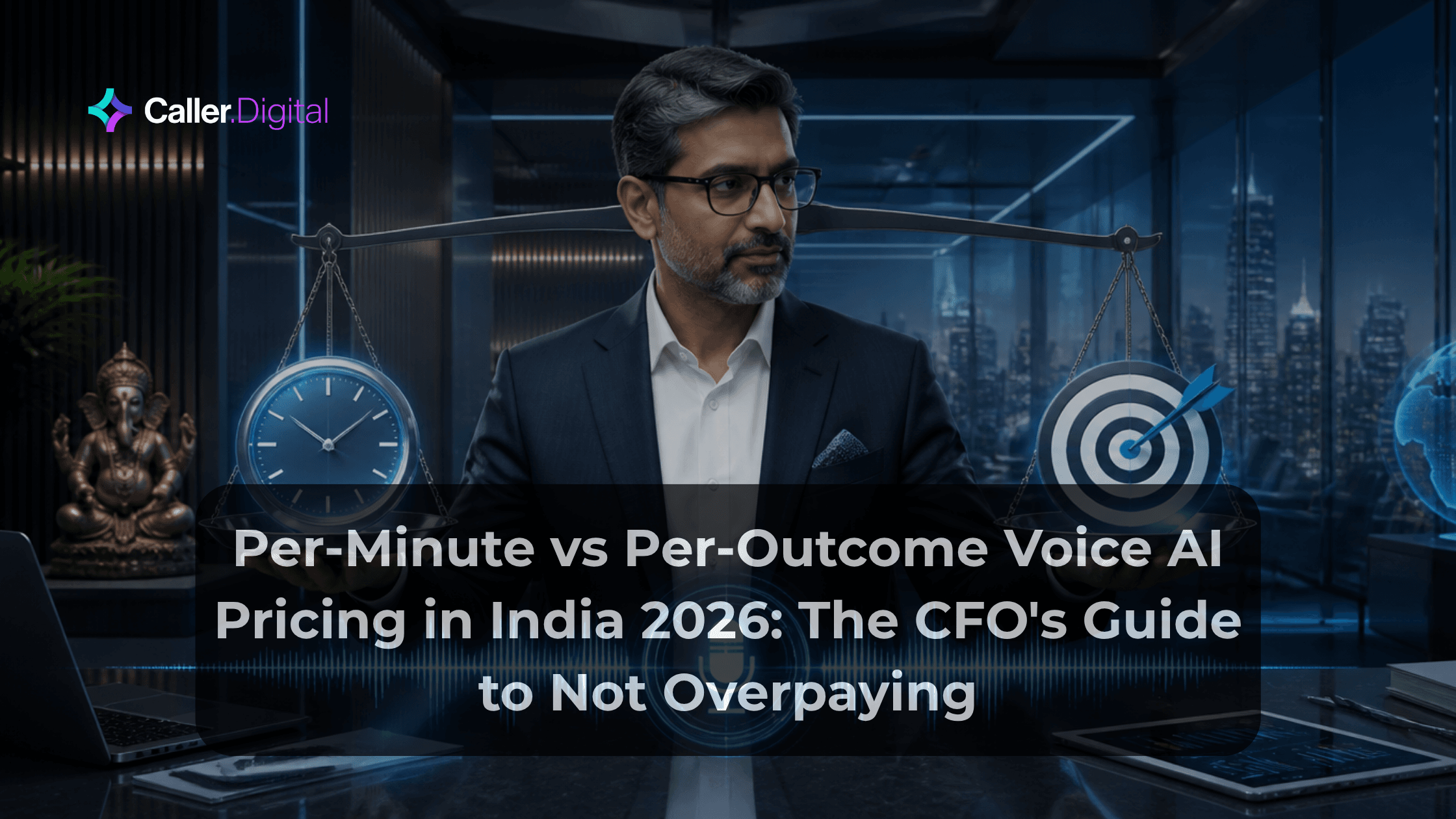
Three quotes are sitting in the CFO's inbox on a Thursday evening. The first is from a US platform: $0.12 per minute, billed in dollars, invoiced on connected duration. The second is from a domestic cloud-telephony player: ₹9 per connected call, minimum commitment of 1 lakh calls a quarter. The third is from an India-first voice AI platform: ₹15 per dispositioned outcome, unconnected attempts free. All three vendors ran the same demo script. All three claim they will be cheapest. The procurement analyst who compiled the comparison sheet has left the "effective monthly cost" column blank, because the three numbers are not the same unit, and nobody in the building can convert between them without knowing six operating assumptions the vendors did not volunteer.
That blank column is where this post lives. Voice AI pricing in India is not confusing because vendors are hiding the numbers — most publish them. It is confusing because the models are structurally incomparable until you fix your own assumptions: connect rate, average handle time, outcome rate, retry policy. Fix those four, and every quote collapses into a single comparable number: cost per outcome. This post walks through the three pricing models sold in India in 2026, the incentive structure each one creates, the hidden lines that inflate invoices 20–40% past the quote, a worked 50,000-call monthly comparison, and the contract clauses worth negotiating before signature.
Why pricing model suddenly matters more than platform choice
Two years ago the Indian voice AI market priced almost everything per minute, because that is how the underlying telephony and speech vendors priced their inputs. The platform's margin was a markup on minutes, and the buyer's finance team treated it like a telecom line item.
Three things changed. First, the input costs collapsed — STT, LLM and TTS costs per conversational minute fell 60–80% between 2024 and 2026, which means a per-minute price set in 2024 is mostly margin today. Second, per-outcome pricing appeared as a genuine alternative: platforms confident in their connect and completion rates started charging only when a call achieves a defined disposition — a confirmed COD order, a captured promise-to-pay, a booked appointment. Third, volumes grew to the point where the model difference is material. At 2,000 calls a month, the gap between models is a rounding error. At 50,000 calls a month — a mid-size NBFC's collection reminders, or a D2C brand's COD verification during sale season — the gap between the best and worst model for your traffic profile runs ₹4–7 lakh a month. That is a full-time analyst's annual cost, every quarter, spent on a unit-conversion mistake.
There is also a quieter reason finance teams are re-opening signed contracts: audits. Two of the deployments we reviewed this year began as a GST reconciliation on a dollar-invoiced per-minute contract, where the import-of-services treatment had been handled inconsistently for three quarters. The pricing-model question walked in through the tax door, and the effective-cost comparison followed.
The full pricing and cost breakdown for voice AI in India covers the input-cost stack in detail. This post is about the commercial layer on top of it.
The three models, and the incentive each one creates
Per-minute: you pay for time, the vendor is paid for length
Per-minute is the import model — most global platforms price this way, typically $0.07–$0.31 per connected minute depending on the voice, model and telephony composition. In rupee terms that is roughly ₹6–26 per minute.
Think about what the vendor is paid for: duration. A 4-minute call earns them twice a 2-minute call, whether or not the customer confirmed the order. Nobody at the vendor is malicious about this, but the incentive gradient is real and it shows up in defaults: verbose agent prompts, longer greetings, confirmation loops that re-read the entire order back. We have audited deployments where trimming the agent's script cut average handle time from 3.1 to 2.2 minutes with no change in completion rate — a 29% invoice reduction the vendor had no reason to hunt for.
Per-minute billing also has a currency problem in India. Dollar invoices move with the exchange rate, land with GST complications on import of services, and make budget forecasting a two-variable problem.
Per-connected-call: you pay for pickups, including useless ones
The domestic middle model: a flat rate — ₹6–12 is the common band — for every call that connects, regardless of duration or result. It looks clean. The catch is the definition of "connected." On Indian mobile networks, a connect includes: the customer's voicemail, a two-second pickup-and-cut, a wrong number, a child answering a parent's phone, and the operator's ringtone-replacement service answering on the customer's behalf. Depending on the data quality of your calling list, 15–30% of "connected" calls achieve nothing and cannot achieve anything — and every one of them is billed.
Per-connected-call is fine when your list is clean and your call is short and transactional. It punishes you exactly when your data is messy, which for most lenders and D2C brands is most of the time.
Per-outcome: you pay for results, and the definition of "result" is the whole contract
Per-outcome pricing charges only when the call achieves a disposition defined in the contract — ₹8–25 per outcome at standard volumes in 2026, with high-volume books (250,000+ outcomes a month) negotiating below ₹8. Unconnected attempts, voicemails and dead pickups cost nothing.
The incentive alignment is obvious: the vendor makes money only when your metric moves, so retries, call timing, list hygiene and script efficiency become the vendor's problem too. A platform on per-outcome pricing will tell you to stop calling a segment that never converts. A per-minute vendor never will.
The trap is equally obvious: everything depends on how "outcome" is defined. A vendor that counts "customer heard the full reminder" as an outcome is selling per-connected-call with better marketing. A real outcome is verifiable and valuable: order confirmed or cancelled (either is an outcome — both save you RTO cost), promise-to-pay captured with a date, appointment slot booked and written to the calendar, lead qualified against agreed criteria. If the outcome definition in the draft contract is vaguer than that, the pricing model is not what it claims to be.
The hidden lines: where quotes and invoices diverge
Across the deployments we have reviewed, the gap between the quoted rate and the effective invoice runs 20–40%. It comes from six places.
| Hidden line | Typical size | Which model it hits hardest |
|---|---|---|
| Unconnected dial attempts | 30–40% of dials on Indian mobile lists | Per-connected models that bill "attempted" tiers; per-outcome unaffected |
| Voicemail and dead pickups | 10–25% of connects | Per-minute and per-connected — both bill these |
| Telephony passthrough | ₹0.30–0.60/min on Indian carriers | Per-minute quotes that exclude carrier cost |
| DLT registration and template fees | ₹5,000–15,000 one-time + per-template charges | All models; usually invoiced separately |
| Setup / onboarding fee | ₹0–2,00,000 | Services-heavy vendors |
| Minimum commitments | 1–3 lakh calls/quarter | Per-connected domestic contracts |
The single most expensive line is the interaction between retries and billing. Indian mobile numbers need 2.5–3.5 dial attempts on average to reach a customer — pickup behaviour clusters between 11am–1pm and 5pm–8pm IST, and a list dialled at 9:30am will retry its way through the afternoon. Under per-outcome pricing those retries are free. Under any model that bills attempts or connects, the retry policy is a pricing decision — and the vendor controls it. Ask who sets the retry cap, and whether you can change it without a change request.
The worked comparison: 50,000 calls a month
Assumptions, stated so you can swap in your own: 50,000 unique customers dialled a month; 65% eventually connect after retries (32,500 connects); average handle time 2.4 minutes on completed conversations; 40% of connects produce a genuine outcome (13,000 outcomes — a COD confirmation rate, or a promise-to-pay rate on a 0–30 DPD book). Exchange rate ₹84.
| Per-minute ($0.12/min) | Per-connected (₹9/call) | Per-outcome (₹15) | |
|---|---|---|---|
| Billable units | 78,000 min | 32,500 connects | 13,000 outcomes |
| Platform cost | ₹7,86,000 | ₹2,92,500 | ₹1,95,000 |
| Retry attempts (85,000 dials total) | ₹0 (unconnected free) | ₹0 | ₹0 |
| Telephony passthrough | +₹46,800 | included | included |
| Monthly total | ~₹8,32,800 | ~₹2,92,500 | ~₹1,95,000 |
| Effective cost per outcome | ₹64.06 | ₹22.50 | ₹15.00 |
Three observations that survive any reasonable change to the assumptions.
Per-minute is rarely competitive for Indian outbound at scale. The combination of dollar rates, billed duration on every connect (including the 25% that achieve nothing), and telephony passthrough puts its cost per outcome at 3–4× the per-outcome model. It wins only when handle time is very short and outcome rate is very high — which is exactly the traffic you least need a vendor for.
Per-connected looks close to per-outcome until your data degrades. Drop the outcome rate from 40% to 25% — a stale lead list, a hard collections bucket — and per-connected's effective cost per outcome jumps to ₹36 while per-outcome stays at ₹15 by definition. The model transfers list-quality risk to you.
Per-outcome's number is the only one that appears directly in a unit-economics review. ₹15 per confirmed COD order against a ₹120 RTO loss per unconfirmed shipment is a sentence a CFO can approve in one reading. The other two models require the conversion table above, every quarter, forever.
Sensitivity: what happens when your assumptions move
A single-scenario table invites the objection that the assumptions were chosen to flatter one model. So move them and watch what happens.
Handle time rises from 2.4 to 3.5 minutes — a more complex script, an older customer base, a regional language with longer constructions. Per-minute cost climbs 46% to roughly ₹12.1 lakh a month; per-connected and per-outcome do not move at all. Every minute of script bloat is invisible on two models and a lakh of rupees on the third.
Connect rate falls from 65% to 45% — a stale list, a hard 60+ DPD bucket, numbers churned since origination. Per-minute and per-connected costs fall roughly in proportion, which sounds like good news until you notice outcomes fell with them: effective cost per outcome barely improves. Per-outcome pricing is flat by construction — ₹15 per result whether the list took 85,000 dials or 140,000.
Outcome rate falls from 40% to 25% of connects — the scenario that separates the models most violently. Per-minute effective cost per outcome jumps from ₹64 to ₹102. Per-connected jumps from ₹22.50 to ₹36. Per-outcome stays at ₹15, and the vendor absorbs the difference — which is precisely why per-outcome vendors audit your list quality before quoting, and why a vendor that quotes per-outcome without asking about your data is either padding the rate or planning to renegotiate.
Volume doubles to 100,000 calls a month. All three models scale linearly unless breakpoints are contracted. This is where the negotiated volume steps matter: a per-outcome contract with breakpoints at 25k and 50k outcomes lands the doubled volume at ₹11–12 per outcome, not ₹15. If the breakpoints live in a sales email instead of the contract schedule, they do not exist.
The general rule falls out of the arithmetic: per-minute transfers script-efficiency risk to you, per-connected transfers list-quality risk to you, per-outcome transfers both to the vendor — and prices that transfer into the rate. You are not choosing a cheaper model; you are choosing which risks you would rather hold.
Which model fits which use case
The traffic profile decides the model more reliably than the vendor pitch does.
| Use case | Typical profile | Model that fits |
|---|---|---|
| COD order confirmation | 30–60s calls, high outcome rate, seasonal spikes | Per-outcome — ₹6–14/verified order vs ₹120+ RTO loss |
| EMI reminders, 0–30 DPD | 1.5–3 min, outcome = promise-to-pay, retry-heavy | Per-outcome — retries free, PTP auditable |
| Lead qualification | 2–4 min, outcome = BANT-qualified lead | Per-outcome, with tight qualification criteria in contract |
| Appointment reminders | 40–90s, near-uniform, high completion | Per-connected acceptable; per-outcome still cleaner |
| Delivery OTP / transactional alerts | 20–40s, uniform, outcome ambiguous | Per-minute or per-connected — outcome definition adds no value |
| Inbound support line | Variable duration, outcome hard to define | Per-minute — the honest model for inbound |
| NPS / CSAT surveys | 1–2 min, outcome = completed survey | Per-outcome — completion is cleanly verifiable |
Two patterns worth noticing. The higher the value of a single result — a saved RTO, a recovered EMI — the stronger the case for per-outcome, because the per-outcome rate is trivially justified against the recovered value. And the more uniform and short the call, the weaker the case, because there is nothing for the model's risk transfer to protect you from. Buyers running four or five workflows should expect a mixed commercial schedule, not force one model across everything.
When per-minute is actually fine
Fairness requires the counter-case. Per-minute pricing is reasonable when: calls are short, uniform and transactional (delivery OTP confirmations averaging 40 seconds); volumes are small enough that model choice is immaterial (under ~5,000 calls a month); you are running a two-week experiment and want zero contract negotiation; or the traffic is inbound, where "outcome" is genuinely hard to define and duration maps acceptably to value. Several teams run a hybrid: per-outcome on outbound campaigns, per-minute on the inbound support line. That is a sensible split, not a contradiction.
If you are still deciding whether to assemble a stack yourself rather than buy either model, the build vs buy analysis for voice AI in India covers the engineering-cost side that pricing sheets omit.
The clauses to negotiate before signing
Pricing model is half the commercial conversation. These clauses are the other half — and they are where the vendor RFP scoring rubric earns its keep.
- Outcome definition, in writing, with examples. For each campaign type: what counts, what does not, and three worked edge cases (customer confirms then calls back to cancel; partial promise-to-pay; appointment booked but slot later unavailable). If the vendor resists specificity here, that is the negotiation telling you something.
- Dispute window and audit access. 30 days to dispute billed outcomes, with call recordings and transcripts available for every billed unit. Per-outcome pricing without recording access is unauditable.
- Volume breakpoints in the contract, not "on request." ₹15 at 10k outcomes should step to ₹11–12 at 50k and single digits at 250k+. Get the steps in writing before you grow into them.
- Retry policy ownership. Who sets attempt caps and calling windows, and can you change them without a commercial amendment.
- No minimum commitment for the first two quarters. Minimums before you know your real connect and outcome rates are the vendor pricing their own uncertainty into your invoice.
- Rupee invoicing. For Indian entities, dollar billing adds GST-on-import handling and FX drift for zero benefit. Domestic platforms invoice in ₹ with standard GST; insist on it.
- Exit and data clause. Recordings, transcripts, consent trails and disposition data export within 30 days of termination, in open formats.
Compliance costs are pricing too
Three regulatory lines belong in the comparison sheet because they differ by vendor, not by model. DLT registration — principal entity and template registration under TRAI's DLT regime — is handled inside the platform by India-first vendors and left to you by global ones; budget ₹15,000–40,000 and two-to-four weeks if it is your problem. DND scrubbing against the TRAI registry must happen at dial-time for promotional traffic; a vendor that cannot show you the scrub log is quoting you a fine, not a price. And DPDP consent storage — purpose-bound consent linked to every call record, stored in India — is a platform feature for domestic vendors and an engineering project on top of US platforms. None of these appear on a per-minute rate card, and all of them are real money.
Running the evaluation: a three-week playbook
Week 1 — fix your assumptions. Pull 90 days of dialler or BPO data: true connect rate after retries, handle time distribution, outcome rate per campaign type. Without these four numbers every vendor comparison is fiction.
Week 2 — run the same 2,000-contact slice through each shortlisted vendor. Same list, same week, same script intent. Demand disposition-level exports. Compute effective cost per outcome from actual invoices, not rate cards.
Week 3 — negotiate on evidence. Take the worked table to the commercial call. Vendors move 20–35% off list pricing when the buyer demonstrably knows their own connect and outcome rates — the information asymmetry is the margin.
Most teams complete this evaluation inside a month. The ones that skip week 1 repeat the whole exercise six months later with an invoice hangover.
What changes in the next 12 months
Expect three shifts. Per-outcome spreads down-market: as more Indian platforms publish outcome rates, per-outcome pricing will reach mid-market and SMB tiers that are quoted per-minute today. Outcome verification gets standardised: expect disposition taxonomies (confirmed / cancelled / PTP-dated / escalated) to converge across vendors, making quotes genuinely comparable for the first time. And per-minute floors keep falling: input costs are still declining, so any per-minute contract signed today should include a rate-review clause at six months — the ₹ per minute that is fair now will be padding by next summer.
Bottom line
Voice AI quotes in India come in three incompatible units, and the conversion factor is your own operating data. Per-minute pricing bills you for time and quietly rewards longer calls; per-connected-call bills you for pickups including the useless ones; per-outcome bills you for results and moves list-quality and retry risk to the vendor — provided the outcome definition in the contract is specific enough to audit. At 50,000 calls a month with typical Indian connect and completion rates, the spread between models runs ₹15 to ₹64 per outcome for identical work. Fix your four assumptions, force every quote into cost per outcome, and negotiate the seven clauses above before signature. The cheapest rate card is rarely the cheapest vendor. Start from outcome-based pricing for Indian deployments, and compare everything else against it — the current rate bands are on the pricing page.
Frequently Asked Questions
Tags :