Voice AI for Indian Matrimony Platforms 2026: Bharatmatrimony, Shaadi, Jeevansathi Playbook for Profile Activation, Upsell, and Subscription Renewal
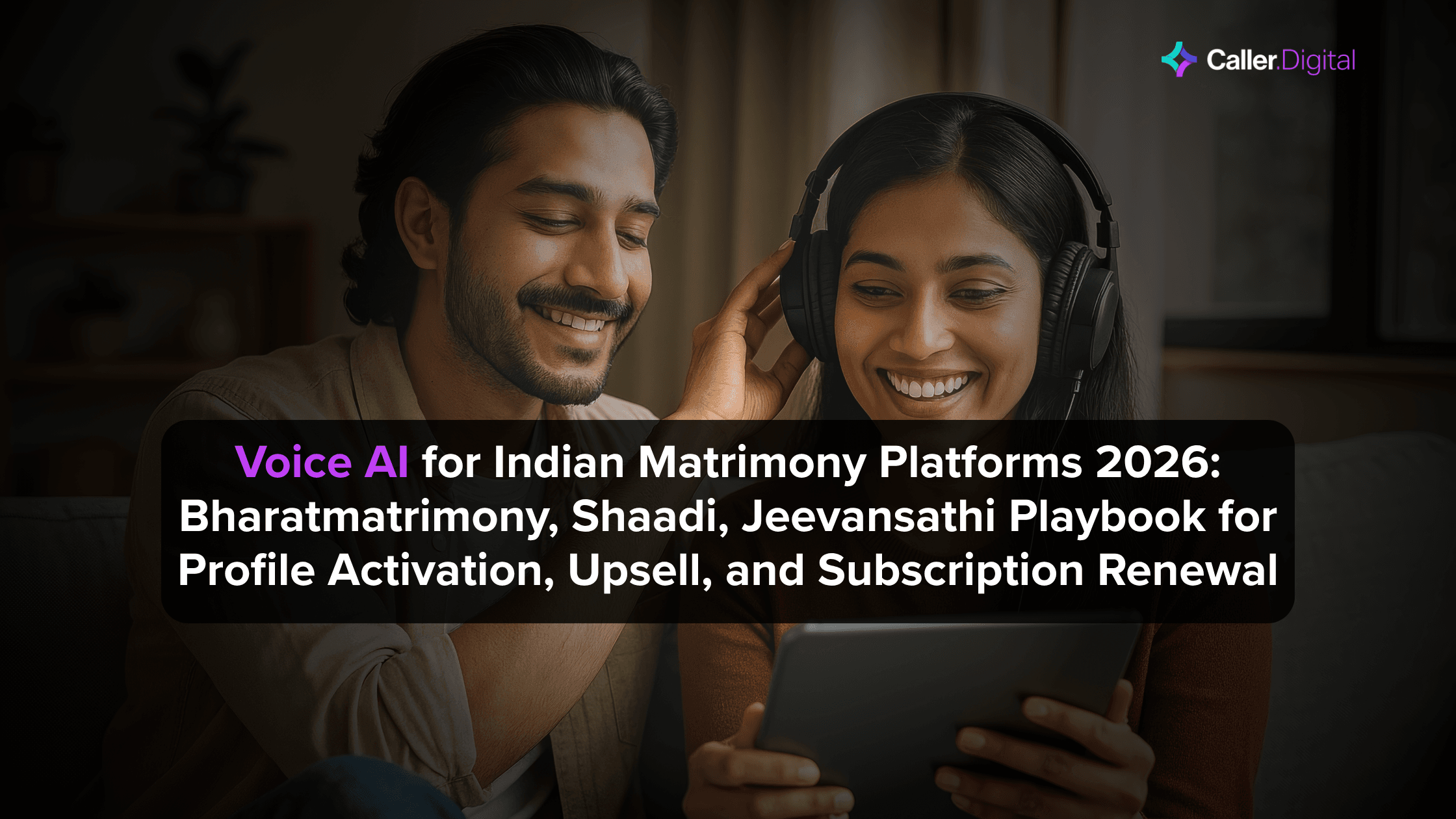
The first 90 minutes after a profile signup is when an Indian matrimony platform's growth team is most vulnerable.
A new user — typically a 24-32 year old or their parent — has just registered on Shaadi.com, Bharatmatrimony, Jeevansathi or one of the regional sites. They have paid nothing yet. They have 0–3 photo uploads, a half-complete preferences screen, and 14 days of free messaging access before the paywall reveals itself. The platform's revenue model depends on converting them — from registered to active, from active to paid, from paid 6-month to paid 12-month, and from a single paid subscription to a renewed annual. The funnel leaks at every step. The single biggest predictor of paid conversion in this category is whether the platform reaches the user with a human-sounding voice in the first 90 minutes after signup.
A platform doing ₹400 crore annual revenue across 8 million registered users typically employs 600–1,400 tele-counsellors across two India locations, working three shifts to maintain coverage across the regional language base — Hindi-English, Tamil, Telugu, Bengali, Marathi, Gujarati, Kannada, Malayalam, Punjabi. Even at that scale, the team cannot cover the signup volume during festival windows (April–June wedding season, October–December engagement-season), when daily new registrations spike 3–5×. The leakage during these windows is the single largest revenue line that voice AI can recover.
This guide is the operator-grade playbook for a head of growth, head of customer success, or head of category at an Indian matrimony platform — Bharatmatrimony, Shaadi.com, Jeevansathi, Matrimony.com (Tamil Matrimony, Telugu Matrimony, Kannada Matrimony, Bengali Matrimony, Marathi Matrimony, Hindi Matrimony), Jodi365, Jeevansathi, BetterHalf, Truly Madly's matrimony-adjacent vertical, or a regional player serving a specific community. It covers what voice AI is and is not for matrimony, the eight use cases that produce measurable subscription revenue lift, the DPDP and TRAI DLT posture that holds up under audit, the vendor comparison, and the 5-week deployment timeline that gets a platform live before the next wedding-season surge.
Why matrimony is a different voice AI problem
The matrimony category has commercial mechanics that no other voice AI vertical shares. The product is a subscription — typically ₹3,000 for a 3-month plan, ₹6,000–9,000 for 6 months, ₹12,000–18,000 for 12 months, with premium tiers running ₹25,000–50,000+ per year. The lifetime of an active subscriber is 4–14 months from first paid plan to marriage or churn. The customer base skews simultaneously young (the user) and older (the user's parent) — and the parent is often the actual decision-maker on the paid upgrade. The language register requirements span 9 Indian languages with regional sub-variants. And the call sensitivity is uniquely high — this is a relationship product, not a productivity tool, and a generic outbound sales script burns the relationship the platform spent money acquiring.
A voice AI deployment that ignores these mechanics will measurably drop CSAT and increase churn. A platform that gets it right will recover 18–30% of subscription revenue that would otherwise leak through the funnel. The chains that have piloted in 2025–2026 have learned this distinction the hard way; the next wave of platforms will benefit from the playbook the early movers built.
The Hindi, Tamil, Telugu, Bengali and Marathi language reality
Matrimony in India is a regional-language product first, English-language product second. Tamil Matrimony's customer base predominantly speaks Tamil at home and prefers Tamil-language outreach; the same is true for Telugu Matrimony, Bengali Matrimony, Marathi Matrimony, and the Hindi-Hindustani users on Bharatmatrimony and Shaadi.com. A voice AI agent that defaults to Hinglish on a Tamil Matrimony user signals "this is a generic platform, not my community platform" and drops the conversion rate by 25–40%.
The harder regional-language test is the code-switching pattern. Indian matrimony users routinely switch mid-sentence between regional language vocabulary, English education and career terms, and Sanskrit-rooted cultural terms — "MBA wala ladka chaiye" mixing Hindi, English credential, and regional preference; "Brahmin Iyer family, software engineer profile" mixing English, caste, and profession; "Pen Pesi adhukku appuram match seyyungal" in Tamil mixing English, romance, and matrimony-specific verb. A voice AI that flattens these registers loses authenticity in 8–12 seconds. A voice AI that handles them well builds the trust the platform's relationship product requires.
The eight use cases that produce measurable subscription lift
Across Indian matrimony platform deployments running for at least four months in 2025–2026, eight use cases consistently produce measurable improvement in profile completion, paid conversion, renewal rate, or churn save. Deploy in this priority order.
1. Profile activation in the first 90 minutes after signup
This is the highest-leverage workflow. The voice AI calls a new registrant within 90 minutes of signup — in the language they selected on the registration form, addressing the user (or the user's parent if the registration was created by family) by name. The call has three goals: photo upload nudge, preferences completion, and a soft introduction of the paid features the user will hit at the paywall.
The metric that matters: from a 100,000-monthly new-registrant pool, voice AI typically lifts paid-plan conversion by 22–38% versus the email-and-app-notification baseline. The reason is mechanical — a voice call within 90 minutes is the only channel that competes with the user's competing platforms (the rival site they signed up to in parallel, which they often do). The platform that calls first wins the relationship.
2. Paid-plan upsell during the free-period friction moment
The matrimony funnel has a structural friction event — typically day 4–7 of free usage, when the user hits the messaging cap or sees the first profile filter they cannot apply. The voice AI use case is the targeted outbound at this moment, with a soft pre-qualification call: "you spoke to 6 profiles, your preferences match 1,400 active members, here's what the paid plan unlocks." Connect rate at this point is materially higher than registration-day calls because the user has demonstrated intent.
The conversion math in 2026: a platform with 80,000 monthly users hitting the day-5 friction point typically converts 8–12% to paid plan on the human telecaller baseline; voice AI at the same moment converts 14–22% — and the unit economics are far better, because the voice AI cost is 30–50% of the equivalent telecaller time.
3. Subscription renewal reminders (60 days before expiry)
A user on a 6-month or 12-month plan has a renewal decision point as the plan nears expiry. The platform's renewal economics are central to lifetime value; a 1-point improvement in renewal rate moves annual revenue meaningfully. The voice AI use case is the 3-touch renewal sequence: T-60 awareness, T-21 with specific premium-feature pitch, T-3 confirmation and renewal link delivery. Renewal rate improvement on the called cohort sits at 11–19 percentage points versus the email-and-push baseline.
4. Partner-profile match notification calls (high-affinity matches)
When the platform's matching algorithm flags a high-affinity match between two paid users — the user's stated preferences align strongly with another active user's profile — a notification call is the highest-conversion channel for surfacing it. The voice AI use case is the targeted outbound: "we found a strong match for you, here's why" with a structured call-to-action (open the profile in the app, schedule a profile review with a paid counsellor, or opt out). This drives both engagement (which extends subscriber lifetime) and upsell into premium tiers that unlock additional features.
5. Voice-based verification for trust badges
Several matrimony platforms have introduced trust badges — verified phone number, verified Aadhaar, verified employment, and increasingly verified voice. The voice AI use case is the verification call itself: the user receives a call, completes a 30-second voice verification (typically a passphrase capture), and earns the verified badge that materially increases their profile interaction rate. The badge increases the platform's premium-tier conversion because users who interact with verified profiles are more likely to upgrade to the premium tier that filters for verified users.
6. Regional language outreach for regional sites
Tamil Matrimony, Telugu Matrimony, Bengali Matrimony, Marathi Matrimony, Gujarati Matrimony, Kannada Matrimony, Malayalam Matrimony, Punjabi Matrimony — each has a primary-language user base that the central platform's Hindi-English telecaller team cannot serve at scale. The voice AI use case is the language-native outbound at every funnel step (activation, upsell, renewal), in the user's language with code-switching that respects the regional register. Connect rates and conversion rates on the regional-language voice AI cohort run 40–65% above the central-team-in-English baseline.
7. Renewal-save on cancellation-intent users
When a paid user hits the cancellation flow — clicks "cancel my subscription" in the app — a voice AI follow-up call within 30 minutes is the highest-conversion save channel. The conversation is short, respectful, listens to the reason, and offers a calibrated save (paused subscription, downgrade to lower tier, or extended trial). Save rates on the called cohort run 22–34% versus 8–14% on email-only save campaigns.
8. Lapsed-user reactivation (6–24 months post-churn)
Lapsed paid users — typically users who churned because they paused their search, took a break, or marriage discussions stalled — represent a high-value reactivation cohort. The voice AI use case is targeted outbound to users 6–24 months post-churn, with a soft check-in conversation: are you still looking, did you find someone, would you like to reactivate. The reactivation rate on this cohort runs 4–7% across a 30-day campaign — a small percentage on a large base produces meaningful incremental revenue.
Vendor comparison: voice AI for Indian matrimony platforms 2026
An honest shortlist for a head of growth at an Indian matrimony platform evaluating voice AI in 2026.
| Platform | Multilingual Indic with code-switch | Subscription funnel depth | Tamil + Telugu + Bengali + Marathi native | Surge handling (wedding season) | Pricing model |
|---|---|---|---|---|---|
| Caller Digital | Hindi + 10 with code-switch native | Pre-built activation + upsell + renewal flows | Native | 4×–5× capacity locked | Per outcome or per minute in ₹ |
| Squadstack | Hindi + regional | AI + human hybrid | Yes | Hybrid surge | Hybrid pricing |
| Gnani | Hindi-first multi-Indic | Configurable | Yes | Configurable | Configurable per-minute |
| Bolna | Hindi + English | DIY API, engineering required | Limited | DIY surge | Per-minute |
| Verloop | Limited regional | Chat-first, voice secondary | Limited | N/A | Per-channel |
| Yellow.ai | Multi-lang | Enterprise multi-channel | Configurable | Configurable | Enterprise contract |
| Exotel (telephony layer only) | N/A | N/A | N/A | N/A | Per-minute telephony |
The pattern for matrimony: the platforms that genuinely handle Tamil, Telugu, Bengali, Marathi and Gujarati at production-grade code-switching quality — Caller Digital, Gnani — are the credible enterprise shortlist. Bolna and Yellow.ai are workable for the central Hindi-English funnel but require build effort for the regional language depth. Squadstack's hybrid AI-plus-human model fits platforms that want a managed-service relationship rather than a SaaS deployment.
Compliance: DPDP Act, TRAI DLT, and the parent-versus-user consent question
Matrimony voice AI sits in a regulatory regime with one unusual dimension that no other vertical shares — the consent question across user and parent.
DPDP Act 2023. Matrimony user data — name, age, photo, preferences, family details, contact, religious and caste preferences if recorded — is Personal Data under the DPDP Act. The platform must hold purpose-bound consent for outbound voice calls — registration-flow consent is sufficient for activation and upsell calls, but a separate consent must be captured for partner-match notifications. India-region data residency applies to call recordings.
The unusual consent dimension: many matrimony registrations are created by a parent on behalf of an adult child. The DPDP consent applies to the adult user (the data principal). Best practice in 2026 is for the registration flow to capture explicit consent from the user (the child) within 7 days of registration, with the parent flagged as authorised contact. Voice AI outbound to the registered phone number is compliant when the consent is properly captured; the platform's vendor selection must ensure the audit trail is producible on request.
TRAI DLT registration. Activation, renewal reminder, and verification calls are Service Implicit. Upsell, premium-tier offer, and partner-match marketing calls are Promotional. The categorisation matters; misclassified templates get rejected by telecom-side filtering. Reference: TRAI TCCCPR 2018.
Specific matrimony sensitivity. Calls referencing the user's religious or caste preferences (the typical Indian matrimony filter) are governed by both DPDP (sensitive personal data) and platform-policy considerations. The voice AI script should reference user-stated preferences neutrally and not attempt to expand on community-specific framing unless explicitly captured. This is a reputation-risk line that vendor selection must respect.
5-week deployment timeline before the next wedding-season surge
A matrimony platform starting from a green field should plan a 5-week deployment to pilot scale, with another 6 weeks to national rollout. The total cycle from contract signature to full national surge readiness is 11 weeks; compressing to 8 weeks is possible for a platform with mature CRM and telephony infrastructure; 15 weeks is realistic for a platform that has neither.
Week 1: scoping and use-case selection. Pick two pilot use cases. Recommended pair: 90-minute activation (highest-volume, highest-leverage) + renewal save (high-revenue, lower-volume, faster signal). These two together reveal the platform's funnel mechanics and the vendor's language handling without exposing the platform to a botched campaign.
Week 2: CRM integration and cohort definition. Connect the voice AI to the platform's CRM and signup webhook. Define the pilot cohort — typically 20,000–35,000 new registrants and 8,000–12,000 cancellation-intent users across one or two language groups. Sign the DPA. Register the DLT templates per category.
Week 3: conversation design and language calibration. Design the activation and renewal-save scripts in each language for the pilot cohort. The matrimony platform's regional managers (not the central team) review every script. This step is the single largest determinant of deployment success — the regional manager catches the language register and community framing errors that a Bangalore-based vendor cannot.
Week 4: pilot launch and live audit. Run on the cohort. Daily review of CSAT, save rate, paid conversion, and language-fidelity audit (sampling completed calls by language for register and code-switch quality).
Week 5: closeout and greenlight decision. Compare against matched control cohort. Decision point: greenlight rollout to the next language and the next 100,000 registrants.
Weeks 6–11: national rollout and wedding-season surge readiness. Expand to all language groups, all use cases (activation + upsell + renewal save + match notification + reactivation), with surge capacity locked in the vendor contract for the April–June and October–December peaks.
Unit economics for an Indian matrimony platform in 2026
Concrete numbers for a platform doing ₹250 crore annual revenue across 5 million registered users and 600,000 active paid subscribers.
| Metric | Voice AI in 2026 |
|---|---|
| Per-minute pricing in ₹ | ₹2.5–6 depending on language mix and volume |
| Monthly call volume (activation + upsell + renewal + match + reactivation) | 800,000–1.6M calls/month at baseline |
| Wedding-season surge multiplier | 3×–5× baseline volume during 8-week surge windows |
| Monthly spend on voice AI minutes | ₹18–45 lakh baseline, ₹55–180 lakh during surge |
| Equivalent telecaller team cost at comparable language coverage | ₹38–95 lakh baseline, ₹1.2–3.5 crore during surge |
| Paid-plan conversion lift vs email-and-push baseline | +22–38% on the called registrant cohort |
| Renewal-save rate on cancellation-intent cohort | 22–34% vs 8–14% baseline |
| Time-to-first-live-call from contract signature | 4–6 weeks for a platform with existing CRM |
The surge mechanic is the procurement question. A matrimony platform's voice AI spend during wedding season is 3×–5× baseline; the vendor that cannot commit to surge capacity at pre-locked pricing is not deployable for this category. This is the single most important contract term in matrimony voice AI procurement.
What changes in the next 12 months for matrimony voice AI
Three shifts to plan against.
The platforms that own the regional language stack will compound. Tamil Matrimony, Telugu Matrimony, Bengali Matrimony and the other Matrimony.com regional brands have a structural advantage in voice AI deployment versus the central Hindi-English platforms — their user base is concentrated in the regional language, their telecaller team already speaks it, and their vendor selection has built-in language expertise. The Hindi-English central platforms (Shaadi, Bharatmatrimony, Jeevansathi) need to invest specifically in regional language voice AI capabilities to compete on the regional segments; the platforms that defer this investment will lose share in non-metro segments through 2026 and 2027.
Voice-based verification will become a category standard. The trust badge programmes — verified phone, verified Aadhaar, verified employment — will extend to verified voice through 2026, driven by both fraud reduction and the user-trust signal in a relationship-driven product. Platforms that build the voice verification workflow first will own the trust signal in their category.
Outcome-based pricing will replace per-minute for the highest-value use cases. Pricing per converted paid plan, per saved cancellation, per verified profile — aligning vendor incentives with the platform's subscription P&L — will become the standard tier-1 matrimony contract structure in 2026. Vendors who refuse to price this way will lose tier-1 deals to those who do.
Bottom line
For an Indian matrimony platform in 2026, voice AI is the funnel layer that handles activation, upsell, renewal save, match notification, regional outreach, and reactivation — at 22–38% higher paid conversion, 22–34% renewal save versus email baselines, and 30–50% lower cost than an equivalent multilingual telecaller team operating at scale. The platforms that procure with surge capacity locked, language depth verified by regional managers in pilot, and outcome-based pricing will compound subscription revenue advantage across 2026 and 2027.
The platforms that defer will find the same competitive dynamic that played out in the EdTech category in 2023 — the early adopters built funnel mechanics the late adopters had to spend materially more to match.
Frequently Asked Questions
Tags :