AI Voice Deepfake Fraud in India 2026: How Legitimate AI Calling Stays on the Right Side of Trust
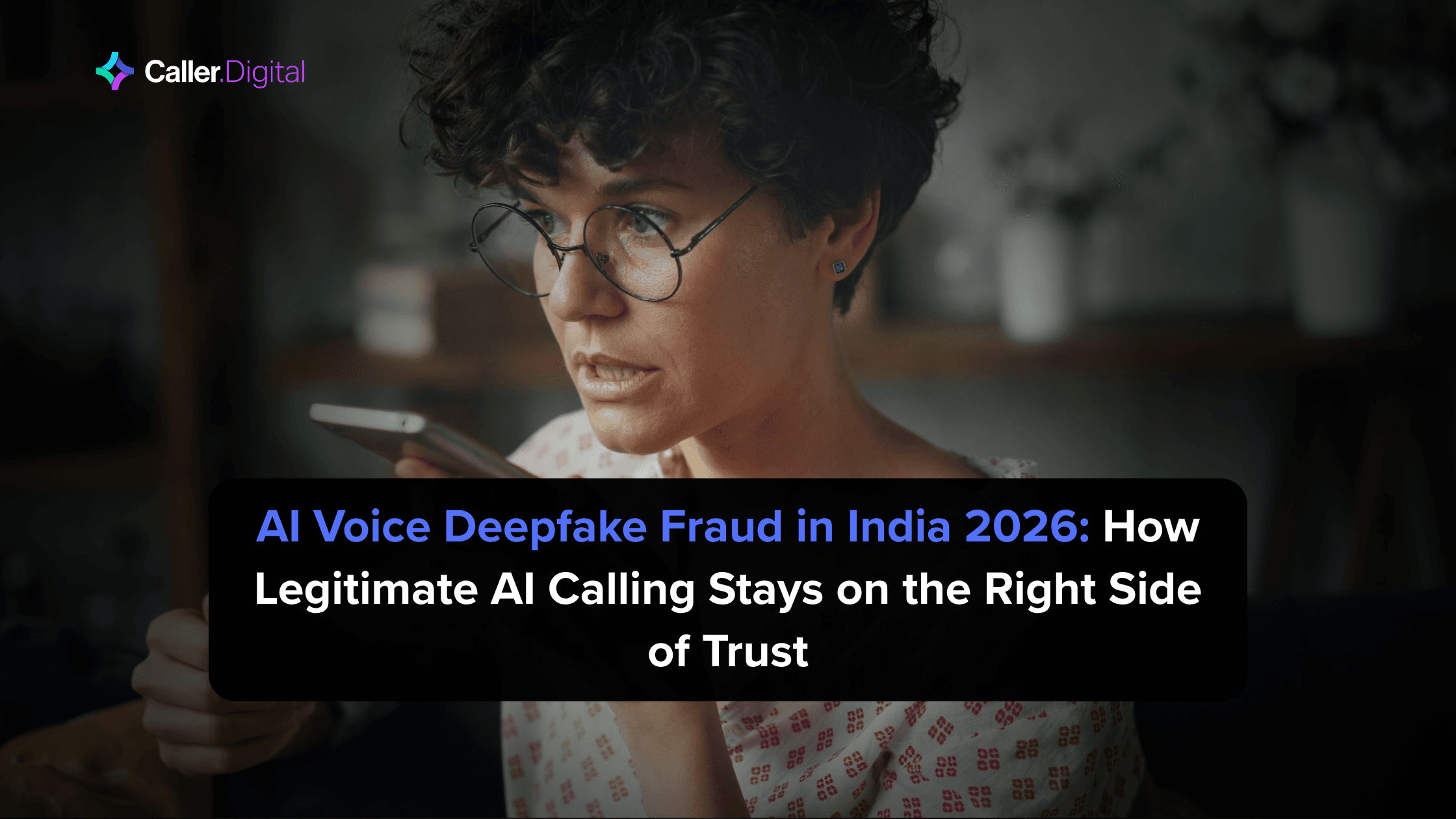
The head of customer experience at a mid-sized private bank got two escalations in the same week this January. The first: a customer in Indore transferred ₹4.2 lakh after a call from someone who sounded exactly like her son, crying, saying he had been in an accident in Pune and needed money for surgery. The second: a different customer filed a complaint against the bank itself, because the bank's own EMI reminder call, a legitimate, DLT-registered, AI-assisted call from its collections partner, "sounded like one of those AI scams" and he wanted it investigated.
Both escalations landed on the same desk. That is the situation every bank, NBFC, insurer, and large D2C brand in India now operates in. Voice-clone fraud is rising fast enough that customers are right to be suspicious of any voice on the phone. And the suspicion does not distinguish between a scammer running a cloned voice off a stolen WhatsApp clip and a regulated lender running a disclosed, consented, compliant AI reminder call. Both get the same raised eyebrow. Sometimes both get the same police complaint.
This post covers both sides of that desk: how voice deepfake scams actually operate in India in 2026, how consumers and finance teams can spot them, what TRAI, RBI, and MeitY have done about it, and what a legitimate AI calling program must do differently so that its calls are verifiable, not just legal. The position we take is simple: the deepfake wave is a category-level threat to everyone who uses the phone channel, and the correct response from legitimate operators is to over-invest in identification and verifiability, beyond what the regulations force you to do.
Why this matters now
Three curves crossed between 2024 and 2026.
First, the cost of producing a convincing voice clone collapsed. Off-the-shelf TTS systems can now produce a usable clone of a specific person from a few seconds of clean audio. That audio is not hard to find: a WhatsApp voice note, an Instagram reel, a customer-care call recording that leaked from a badly secured BPO. What used to require a studio and a specialist now requires a laptop and a stolen clip.
Second, the losses became large enough to show up in national statistics. The Indian Cyber Crime Coordination Centre (I4C) has reported that Indians lost thousands of crores to digital fraud in recent years, with the Ministry of Home Affairs citing losses of over ₹120 crore to "digital arrest" style scams in just one quarter of 2024. Those are reported figures; underreporting in fraud cases is chronic, because victims are embarrassed. The real number is higher.
Third, legitimate AI calling scaled at the same time. Banks, NBFCs, hospitals, and e-commerce brands in India now run millions of AI-assisted outbound calls a month for EMI reminders, delivery confirmations, and renewal notices. The two curves, fraudulent synthetic voice and legitimate synthetic voice, are rising together, and the average customer cannot tell them apart by ear anymore. Ear-based trust is dead. What replaces it is infrastructure-based trust: number series, caller-name presentation, disclosure, and verifiable callbacks. That is what the rest of this post is about.
The anatomy of voice-clone fraud in India
Understanding the scam patterns is the first defence, for consumers and for the enterprises whose customers are being targeted. We describe these at the level needed to recognize them, not to reproduce them.
The family-emergency clone
The oldest social-engineering script, upgraded. The victim receives a call from an unknown number. The voice is a son, daughter, or grandchild, cloned from social media audio, in distress: an accident, an arrest, a hospital admission. The ask is always urgent money movement, usually UPI, before "it's too late." The clone does not need to survive a long conversation. It needs 40 seconds of panic, then the phone is often handed to a "doctor" or "police officer" (the actual scammer) who takes over the logistics of the transfer.
The fake bank or RBI officer
A caller claiming to be from the victim's bank, from RBI, or from a card network says the victim's account is implicated in money laundering, or that KYC has expired and the account will be frozen within hours. The voice may be a generic professional voice rather than a clone; the deepfake element increasingly appears in a second stage, where victims receive a follow-up call that spoofs a relative or a known bank manager. RBI has repeatedly stated in its public advisories that it never calls individuals asking for account details, OTPs, or fund transfers. The scam works because the victim does not know that.
The digital-arrest scam
The most damaging pattern by rupee value. Victims are told, over a call and often a video call with uniformed imposters, that they are under "digital arrest" for a crime (drug parcels, money laundering, obscene material) and must remain on the line and transfer funds to "verification accounts" to avoid physical arrest. There is no such thing as digital arrest under Indian law. The Ministry of Home Affairs and I4C have run public campaigns saying exactly this, and the government has blocked tens of thousands of SIMs and devices linked to these operations. Synthetic voice enters this pattern as cloned "senior officers" and as scripted, multi-hour pressure calls that would exhaust a human scam crew.
CEO fraud on finance teams
The corporate variant. An accounts-payable executive gets a call that sounds exactly like the CFO or founder: approve this vendor payment today, the deal closes tonight, keep it confidential. The clone source is abundant for any founder who has ever spoken on a podcast or an earnings call. Indian mid-market companies are soft targets because payment approval chains are often one WhatsApp message deep. The known defence is procedural, not auditory: no payment instruction accepted by voice alone, ever, regardless of who it sounds like.
What all four have in common
Urgency, secrecy, and a demand that money or credentials move during the call. No legitimate institution in India operates that way. That single sentence, repeated to customers often enough, prevents more fraud than any detection technology currently deployed.
Scam call vs legitimate AI call: the tell-tale table
| Scam pattern | Tell-tale signs | What a legitimate call does differently |
|---|---|---|
| Family-emergency voice clone | Unknown 10-digit mobile number, extreme urgency, refuses callback, demands UPI transfer now | A real emergency survives a callback to the family member's own number; legitimate institutions never demand instant transfers |
| Fake bank / RBI officer | Threatens account freeze in hours, asks for OTP, card number, or remote-access app install | Banks call from registered 1600-series numbers, never ask for OTPs or credentials, and invite you to call back on the number printed on your card |
| Digital arrest | Claims police can arrest you over video call, demands you stay on the line, routes money to "verification accounts" | No such procedure exists in Indian law; real police do not take payments and do not conduct arrests over video calls |
| CEO fraud on finance teams | Voice-only payment instruction, confidentiality pressure, bypasses normal approval chain | Legitimate approvals follow the written workflow; any voice instruction is confirmed on a separate, known channel before money moves |
| Fake delivery / refund call | Asks you to "verify" via OTP or a payment link for a refund | Legitimate delivery confirmation calls (COD verification, for instance) never ask for OTPs or payments; they only confirm intent |
The right column is the part enterprises control. Every row of it is an operating decision, not a technology purchase.
Why cloning got cheap, and why that is not the interesting question
Commentary on voice deepfakes tends to fixate on the generation side: how little audio is needed, how good the prosody has become. That framing leads to an arms-race conclusion, detection models fighting generation models, and it is mostly a dead end for the people reading this. Detection accuracy degrades on compressed telephony audio (8 kHz, narrowband, packet loss), which is exactly where these scams live. A detection model that scores 95% on clean studio samples can fall to coin-flip territory on a real Jio-to-Airtel call. Anyone selling you real-time deepfake detection as a complete answer is selling a demo.
The interesting question is the one telecom regulators asked: if you cannot reliably verify the voice, verify the channel. Who is allowed to call from which numbers, under what registration, with what name displayed. That is a solvable infrastructure problem, and India is further along on it than most countries.
The regulatory response: TRAI, RBI, MeitY, DPDP
Four regulatory threads converged on this problem, and a compliance head should be able to recite all four.
TRAI's number-series segregation. Under the Telecom Commercial Communications Customer Preference Regulations (TCCCPR) framework, TRAI mandated dedicated number series for commercial calling: the 140 series for promotional and telemarketing calls, and the 1600 series for transactional and service calls from regulated entities such as banks, insurers, and other financial institutions. The point is trainable consumer behaviour: a service call from your bank arrives from a 1600-series number, a promotional call arrives from 140, and an "RBI officer" calling from a random 10-digit mobile number is by definition not what he claims to be. TRAI's regulations and press releases are on trai.gov.in. If your outbound program, human or AI, still dials customers from ordinary 10-digit CLIs, you are training your customers to trust exactly the pattern scammers use.
CNAP, caller-name presentation. TRAI has pushed Calling Name Presentation (CNAP) so the receiving handset displays a verified, KYC-backed name rather than a bare number. Rollout has been staged across operators and handsets, but the direction is set: within the planning horizon of anyone reading this, your customers will see a verified name on inbound calls. Enterprises that register clean, recognizable display names early will benefit; those that show up as an unfamiliar LLP name registered by their BPO vendor will not.
RBI's fraud advisories. RBI has issued repeated public advisories, available on rbi.org.in, stating that neither RBI nor banks ask for OTPs, PINs, or fund transfers over calls, and warning specifically about impersonation of RBI officials. RBI-regulated entities are expected to run customer-awareness programs on these fraud patterns. If you are a bank or NBFC, your AI calling scripts should reinforce these advisories, not merely avoid violating them.
MeitY's deepfake advisories and DPDP 2023. The Ministry of Electronics and IT has issued advisories to platforms on deepfake content under the IT Rules, with due-diligence obligations around synthetic media (meity.gov.in). Separately, the Digital Personal Data Protection Act 2023 governs the voice data itself: call recordings are personal data, consent must be purpose-bound, and a leaked recording archive is now a statutory liability as well as the raw material for cloning your own customers. Where your recordings live, who can export them, and how long they are retained is a fraud-surface question, not just a data residency and DPDP compliance question.
How consumers can spot a voice-clone scam
This section is deliberately written to be quotable. Share it with your customers verbatim if you like.
- Ignore the voice, check the behaviour. A cloned voice sounds real. What gives the scam away is what the caller wants: money moved or credentials shared during the call, under time pressure. No bank, no police force, no government agency in India operates that way.
- Hang up and call back on a number you already have. The number on your debit card, the son's own saved contact, the official app. A real emergency survives a two-minute callback. A scam almost never does.
- Agree on a family code word. A word or question only the real person would know. It costs nothing and defeats a clone built from public audio instantly.
- Read the number series. Calls from 1600-series numbers are registered service calls from regulated entities. Calls from 140-series numbers are registered telemarketing. A "bank officer" on a normal mobile number is an impersonator.
- There is no digital arrest. No Indian law enforcement process involves staying on a video call and transferring money. Anyone who says otherwise is a criminal, however convincing the uniform.
- Report fast. Dial the cybercrime helpline 1930 or file at cybercrime.gov.in. Speed matters: money that is reported within the first hour is far more likely to be frozen in transit.
The operator playbook: making legitimate AI calls verifiable
Now the other side of the desk. You run, or are about to run, an AI calling program: collections reminders, lead qualification, renewals, delivery confirmation. Your problem is not just complying with TCCCPR. Your problem is that your calls land in an environment poisoned by the scams described above. Here is what the credible operators do.
Disclose that the call is AI, in the first sentence
Not because a specific Indian regulation currently forces the wording, but because every direction of travel (TRAI consultations, MeitY advisories, global norms) points there, and because it works. Our observation across Indian deployments is consistent: upfront disclosure ("this is an automated assistant calling from X") costs a small number of early hang-ups and measurably improves completion and complaint rates on the rest. Customers who continue past a disclosure are consenting participants; customers who discover mid-call that they were talking to a machine feel deceived, and deceived customers file complaints. Hiding the AI is bad ethics and bad economics at the same time.
Dial from the right number series, always
Transactional and service calls from 1600-series CLIs where you qualify as a regulated entity, promotional from 140. Consistently, across every campaign and every vendor. The whole consumer-education value of the series collapses if your own campaigns leak onto ordinary mobile numbers because one telecaller vendor found them cheaper. The same discipline applies to TRAI DLT registration: headers and templates registered, consent scrubbed at dial time, not at queue time.
Give every call a verification path
The single most under-used trust mechanism. Every AI call should be able to say: "If you want to verify this call, hang up and call the number on the back of your card, or check the notification in your app." A scammer can never say that sincerely, because verification kills the scam. A legitimate caller who offers verification is borrowing trust from a channel the customer already controls. Banks that pair outbound AI calls with a simultaneous in-app notification ("our assistant is calling you about your EMI due on the 7th") see materially higher answer and completion rates on retry attempts.
Keep audit trails you would be happy to show a regulator, or a court
Full recording (with disclosed recording notice), transcript, consent reference, DLT template ID, CLI used, opt-out events, all retrievable per call. When a customer alleges your call was a scam, or a scammer impersonates your brand, your defence is the audit trail. This is also where 100% call QA and scoring earns its keep: you cannot claim your AI never asked for an OTP unless you can search every transcript and prove it.
Honor opt-out in-call, instantly
"Stop calling me" must work as a spoken sentence, mid-call, and propagate to the suppression list before the next campaign run. Under DPDP's purpose limitation and TCCCPR's preference framework this is an obligation; operationally it is also self-defence, because ignored opt-outs are the fastest route to complaints that get your headers blocked.
Never collect credentials by voice
Design the boundary into the agent, not into the script. A legitimate AI agent for a bank or NBFC should be structurally incapable of asking for an OTP, PIN, CVV, or password: those intents blocked at the orchestration layer, flagged in QA if they ever appear in a transcript. This is the brightest line between your calls and fraud calls, and you want to be able to state it as an engineering fact, not a training guideline.
What to demand from your voice AI vendor: the checklist
If you are evaluating vendors for an AI calling program in BFSI or any regulated sector, put these on the RFP. A vendor who hesitates on more than two of them is a risk you will wear publicly.
- Disclosure by default. AI identification in the first utterance, configurable in wording but not silently removable by a campaign manager.
- Number-series and DLT discipline. Native support for 140/1600-series CLIs, DLT template binding per campaign, dial-time consent scrubbing, and rejection (not silent dropping) of unscrubbed records.
- Consent and opt-out logs. Per-call consent reference, spoken opt-out honored in-call, suppression propagation SLA in writing (ask for minutes, accept hours, reject "next campaign cycle").
- Recording notice and retrieval. Disclosed recording, per-call retrieval of audio plus transcript plus metadata within minutes, retention policy configurable to your DPDP posture.
- Data residency. Where audio is processed and stored, which sub-processors touch it, and whether any voice data leaves India. Get the sub-processor list in the contract, not the sales deck.
- Credential guardrails. Written confirmation that the agent cannot solicit OTPs, PINs, or passwords, enforced at the platform layer, verifiable in transcripts.
- Distinct, licensed agent voices. The vendor's TTS voices should be licensed, documented, and not clones of identifiable private individuals. Ask how the vendor prevents its own tooling from being used to clone arbitrary voices, and whether generated audio carries watermarking or provenance signals where the TTS provider supports it.
- Brand-impersonation response. What the vendor does when scammers impersonate your brand on the phone channel: can they help you distinguish your registered traffic from spoofed traffic when a customer complaint arrives?
The numbers: what trust is worth
Trust shows up in the metrics faster than most operators expect. Ranges below are from Indian deployments we have observed and from what regulated clients report; treat them as directional, not gospel.
- Answer rates on registered series. Campaigns moved from plain 10-digit CLIs to registered series with consistent identity see answer rates recover over 3 to 6 weeks as customers learn the pattern, typically a 15 to 30% relative lift on second and third attempts.
- Disclosure economics. Upfront AI disclosure costs roughly 3 to 6% in immediate hang-ups and reduces complaint escalations by a larger factor. Completion rates among customers who stay are higher than on undisclosed calls, because nobody feels ambushed mid-conversation.
- Verification callbacks. Offering an in-app or official-number verification path on high-stakes calls (limit changes, renewals above ₹50,000, settlement offers) increases eventual conversion despite adding a step. The customers you lose at the verification step were mostly not going to convert anyway.
- Complaint asymmetry. One upheld TCCCPR complaint can block headers and stall an entire month's campaign calendar. The cost of over-compliance is linear; the cost of a blocked header is a cliff.
What changes in the next 12 months
Expect four shifts. CNAP coverage will widen, and verified caller names will start to be table stakes; enterprises should be registering display names now, not after rollout completes. TRAI's enforcement against unregistered commercial traffic will keep tightening, and the arbitrage of dialing from ordinary SIM banks will get more expensive and more criminal. Provenance signalling in synthetic audio (watermarks, C2PA-style attestations from major TTS providers) will move from research to procurement checklists, and vendors without a story will start losing regulated deals. And scammers will move up the stack: as number-series education spreads, expect more fraud over app-based and WhatsApp voice, where telecom-layer defences do not reach, which will make institutional in-app verification paths even more valuable.
The bottom line
Voice deepfake fraud in India is not a future risk; it is a present-tense drain measured in thousands of crores, and it degrades trust in every phone call, including yours. Ear-based trust is finished. What replaces it is verifiable infrastructure: 140 and 1600 number series, CNAP names, DLT registration, upfront AI disclosure, callback verification, and audit trails that hold up under a regulator's gaze. Legitimate AI calling operators should treat the scam wave as a mandate to over-invest in identification, because every verifiable call they place rebuilds a little of the trust the scammers are burning. The operators who hide their AI, dial from anonymous numbers, and treat compliance as a floor will find that customers, and eventually regulators, stop distinguishing them from the fraud they imitate.
Frequently Asked Questions
Tags :