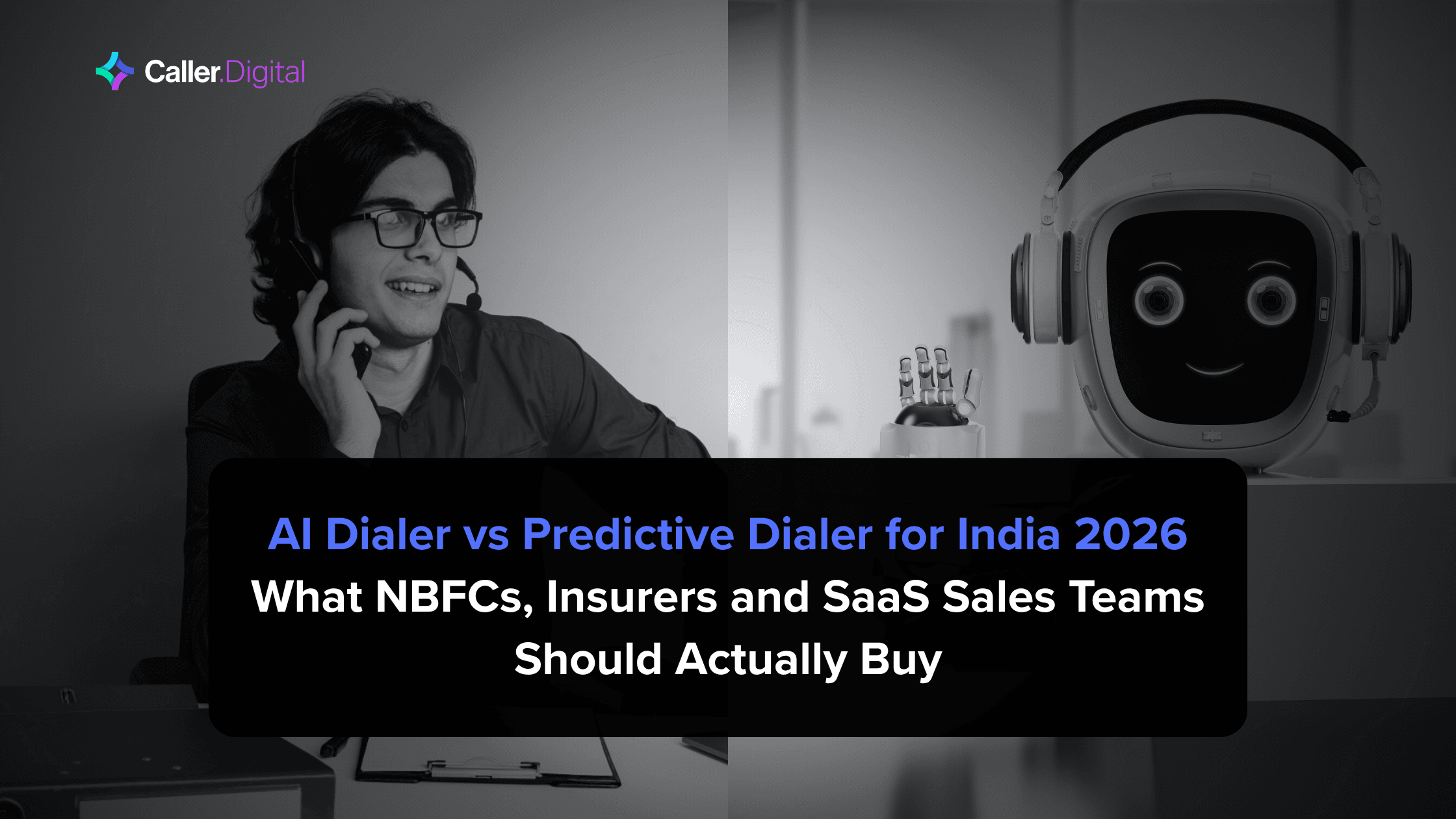
AI Dialer vs Predictive Dialer for India 2026: What NBFCs, Insurers and SaaS Sales Teams Should Actually Buy
The head of collections at a Mumbai NBFC is looking at two vendor decks side by side. One is from an established predictive-dialer vendor she has used for six years — the same one her previous employer used. The other is from a voice-AI startup that has been coming up in every RBI collections conference for the past year. Both decks show similar-looking dashboards. Both promise higher contact rates. Both list familiar NBFC logos as customers. Her CTO has asked her a simple question: what is actually different? Because if the answer is "the AI dialer is a better predictive dialer", she will renew the incumbent and move on. If the answer is "these are different categories of tool", she needs to run a real evaluation.
This is the question every collections head, insurance sales VP, and B2B inside-sales leader in India is asking in 2026. The answer matters because the wrong pick is a 3-year mistake — dialer contracts are sticky, integration to LOS and CRM is painful to undo, and the shift in agent behaviour is hard to reverse. The two are not the same tool with different marketing. They are architecturally different systems that solve overlapping but distinct problems.
The thesis
A predictive dialer maximises human agent talk-time. An AI dialer removes the human agent from the routine calls entirely. Neither is universally better — they are optimised for different economics. Predictive dialers win when the conversation genuinely needs a trained human (complex collections settlements, insurance product upsells above ₹50k premium, enterprise B2B closes). AI dialers win when the conversation is bounded, script-able, and repeated at volume (EMI reminders, KYC nudges, appointment confirmations, cold-lead qualification, NDR recovery). Most Indian mid-market operations need both, deployed to different call queues. The question is not "which one" — it is "which queues should each own".
Why this question matters more in 2026 than it did in 2024
Three shifts in 24 months made this a real decision, not a marketing distinction.
Voice AI got good enough for real Indian telephony. In 2024, most AI dialers could handle scripted English conversations but broke on Hindi telephony audio — Word Error Rate on Delhi-Hindi test sets was around 12–15%, and on Patna Hindi or Bhojpuri-influenced Hindi it climbed above 20%. In 2026 the better AI dialers run Hindi telephony WER at 6–9% and cover 8–13 Indian languages at production quality. That crossed the threshold where AI can hold real collections and sales conversations, not just deliver menu-driven IVR.
RBI Fair Practices Code and DPDP 2023 changed the compliance surface. Collections calls in India face tighter recording, retention, and consent obligations than in 2022. The RBI recovery norms (July 2026) require documented call trails, and the DPDP purpose-binding forces you to segregate collection call data from marketing data. Both AI dialers and predictive dialers can be compliant, but the audit trail an AI dialer generates natively — every state transition logged, every intent detected, every consent captured — is easier to defend in an RBI inspection than a human agent's typed disposition.
The unit economics inverted for high-volume, low-complexity calls. Predictive dialer economics — ₹120–₹180 per hour per human agent, seat licence + telephony + supervisor overhead — mean each dialed call costs ₹8–₹18 depending on talk-time. AI dialer economics — ₹4–₹8 per minute of call, no seat licence, no supervisor — mean the same call costs ₹3–₹7. For repeat, script-able calls (EMI reminders being the archetype), the AI dialer is 40–70% cheaper per call. For high-value, unscripted calls (complex collection settlement), the human agent's ability to close makes the predictive dialer economics still work.
The right answer is now segmentation of call queues by complexity, not choosing one tool for the whole operation.
The architectural difference — what each system actually does
A predictive dialer's job is to keep human agents talking. It dials 3–7 numbers simultaneously per available agent, uses answer-machine detection to filter out voicemails and disconnected lines, and connects the first real human answer to the next available agent. The core algorithm predicts how many lines to dial based on historical answer rates, average call duration, and current agent availability. The dialer is a scheduler. The value is in maximising human agent utilisation from ~35–40% (manual dialing) to ~70–80%.
An AI dialer's job is to handle the entire conversation without a human. It dials one number at a time (or in modest parallelism), an AI voice agent picks up the conversation, and the agent walks through a scripted state machine — greeting, identity confirmation, intent capture, action, closure. Complex or edge-case calls escalate to a human. The core capability is voice-to-voice conversation quality. The value is in removing the human agent from the routine call entirely.
The tables below make this concrete.
System comparison at the component level
| Component | Predictive Dialer | AI Dialer |
|---|---|---|
| Dialing strategy | Multi-line parallel dial with abandonment | Single-line or modest parallelism |
| Answer detection | Rule-based (voicemail vs human) | Full ASR-based intent detection |
| Conversation handling | Human agent | Voice AI agent + human escalation |
| Talk-time optimisation | Agent utilisation ratio | Not applicable (no human on routine calls) |
| Scripting | Agent training + soft-script UI | Deterministic state machine |
| Language handling | Whatever the agent speaks | 8–13 Indian languages, code-switching |
| Compliance trail | Agent disposition + call recording | Every state transition + intent logged |
| Escalation | Rare — usually manager takeover | Native — routine → human on complexity |
| Marginal cost of call | Human agent hourly cost dominates | Per-minute telephony + per-minute AI |
| Peak capacity | Bounded by agent count | Bounded by telephony gateway capacity |
Where each wins
| Use case | Better fit | Why |
|---|---|---|
| EMI reminders (₹5k–₹50k tickets) | AI dialer | Bounded conversation, high volume, script repeats |
| Soft-bucket NBFC collections (DPD 1–15) | AI dialer | Scripted, gentle, high volume, low commercial risk |
| Hard-bucket collections (DPD 60+) | Predictive dialer + AI triage | Settlements need human judgment; AI can pre-qualify willingness to pay |
| Insurance renewal reminders (auto, health under ₹25k premium) | AI dialer | Script-able, notification-style |
| Insurance sales — high-value life / ULIP | Predictive dialer | Consultative conversation, product complexity, upsell judgment |
| Cold B2B sales outreach (top-of-funnel qualification) | AI dialer | Repeat script, disqualify quickly, book demo if qualified |
| B2B enterprise close (>₹10L ACV) | Predictive dialer or human dialing | Relationship, negotiation, custom terms |
| Lead qualification for edtech / real estate | AI dialer | High volume, standard qualification questions |
| Customer support / complaint resolution | Predictive dialer or omnichannel | Empathy, judgment, unbounded scope |
| Appointment booking / confirmation | AI dialer | Deterministic outcome |
| KYC follow-ups / document reminders | AI dialer | Notification + light collection of info |
| Feedback / NPS calls | AI dialer | Structured, no negotiation |
| Missed-call callback | AI dialer | Trigger-driven, short conversation |
Where teams get the buy decision wrong
Mistake 1 — Assuming AI dialer will handle all calls. The teams that get burned deploy an AI dialer for all outbound and then face a wave of customer complaints because complex collection cases, angry customers, and edge-case product questions get poorly handled by a bounded state machine. Fix: define which queues are AI-suitable up front. Rule of thumb — if the average handle time of a human agent is under 3 minutes and the disposition distribution has one dominant outcome (e.g., 70% "will pay by date X"), it is AI-suitable. If AHT is over 6 minutes and disposition is uniformly distributed across 8+ codes, it is human-suitable.
Mistake 2 — Buying an AI dialer that is really a fancy IVR. Some vendors market IVR menu trees + text-to-speech as "AI dialer". The tell — ask for a live demo where the customer says something the vendor did not pre-script. If the system falls back to "I did not understand, please try again", it is not a voice AI agent. It is an IVR. A real AI dialer handles unbounded natural conversation within its state machine boundaries.
Mistake 3 — Not budgeting for the human escalation team. 8–15% of calls need human handoff. If your existing collections team is 30 people and you switch to AI dialer for the soft bucket, you cannot fire 27 of them. You need 4–6 for escalation queue handling. The savings come from redeploying those 24 people to hard-bucket work — not from headcount reduction alone.
Mistake 4 — Ignoring the compliance implications of state-machine determinism. Predictive dialer + human agent means every collections call has some variance in what was said — human agents interpret the situation. Under RBI Fair Practices Code, that variance is your compliance risk. AI dialer state machines say exactly what you programmed. If your state machine is compliant, every call is compliant. That is a feature for regulated industries; it is not for consultative sales.
Mistake 5 — Underestimating integration effort. Both systems need to integrate with your LOS, CRM, and telephony. Predictive dialers have 15 years of integrations to Salesforce, Zoho, Freshdesk. AI dialers vary — the best have native Salesforce / HubSpot / Zoho connectors, the worst rely on Zapier or webhook glue. Ask specifically about the integration model with your systems before you sign.
The unit economics — worked example
A worked example for a mid-size NBFC with 40,000 EMI reminder calls per month.
Predictive dialer setup.
| Line | Cost |
|---|---|
| 12 human agents × ₹22,000/month | ₹2,64,000 |
| 2 supervisors × ₹35,000/month | ₹70,000 |
| Predictive dialer licence (12 seats) | ₹48,000 |
| Telephony (40,000 calls × avg 90 sec × ₹0.60/min) | ₹36,000 |
| Recording storage + compliance tools | ₹18,000 |
| Total monthly cost | ₹4,36,000 |
| Cost per call | ₹10.90 |
| Successful outcome rate (customer confirms payment date) | ~54% |
| Cost per successful outcome | ₹20.19 |
AI dialer setup for the same volume.
| Line | Cost |
|---|---|
| AI dialer platform (per-minute pricing at ₹5.5/min avg conversation 55 sec) | ₹2,01,000 |
| Human escalation team — 4 agents × ₹24,000 | ₹96,000 |
| 1 supervisor × ₹35,000 | ₹35,000 |
| Telephony (bundled with platform in most cases) | included |
| Integration + hosting | ₹15,000 |
| Total monthly cost | ₹3,47,000 |
| Cost per call | ₹8.68 |
| Successful outcome rate (customer confirms payment date) | ~52% |
| Cost per successful outcome | ₹16.69 |
Net saving: ~₹89,000/month, or ~20% lower unit economics at the same successful-outcome rate. That is meaningful but not transformational.
The bigger win shows up when you look at what the 12 redeployed agents can now do. If 8 of them move to hard-bucket collections at DPD 60+, and each successful settlement is worth ₹8,000–₹40,000 in recovered principal, the incremental recovery revenue swamps the direct cost saving. That is the real business case — you are not just saving on soft-bucket costs, you are freeing your best human agents to work on the highest-value queue.
For B2B inside sales at a SaaS company, the math looks different. A predictive dialer team costs ₹6–₹9 per dialed call because agent costs are higher (₹28k–₹45k/month per SDR). An AI dialer running top-of-funnel qualification costs ₹4–₹6 per dialed call with 40–55% qualification rates. But your human closer still needs to speak to the qualified leads — so the AI dialer replaces the SDR (top of funnel) and augments the AE (closer). Headcount economics: you might run 3 AEs + 1 AI dialer instead of 3 AEs + 6 SDRs.
Compliance surface for Indian buyers
TRAI DLT. Both dialers must scrub against the National Customer Preference Register at dial-time (not queue-time). Both must have registered sender headers. AI dialers built for India handle this natively; predictive dialers built for the US market often need a DLT integration layer that not every deployment configures correctly.
RBI Fair Practices Code (July 2026 revisions). All collection calls must be recorded, retained per policy, and identifiable to a specific agent + timestamp. The AI dialer's per-state-transition log is a cleaner audit trail than a human agent's disposition notes. For RBI inspection defensibility, this is meaningfully better.
DPDP 2023 purpose binding. Collections data cannot be used for marketing without separate consent. The AI dialer's deterministic script guarantees no accidental cross-use of the data during the call. Human agents on predictive dialers occasionally step outside script (well-intentioned upsell suggestion during a collection call) — a compliance risk that is easier to eliminate on an AI dialer.
IRDAI recording requirement for insurance sales. Every insurance sales call must be recorded and disclosed. Both dialers handle this. The advantage of AI dialer state machines is that the recording disclosure is guaranteed to be delivered in the correct language and phrasing every time.
Consumer Protection E-commerce Rules 2020. For any dialer used in a D2C or e-commerce context, the disposition data must support the 7-working-day refund SLA. Both handle this; AI dialer disposition data is machine-readable by default.
The compliance posture is not the deciding factor between the two — both can be compliant. But the AI dialer's determinism makes compliance easier to maintain at scale.
How to run the buy decision — a 6-step process
Step 1 — Segment your outbound queues. List every outbound calling queue you run today. For each, record: monthly volume, average handle time, top 3 disposition codes and their frequency, average commercial value of a successful outcome, and current cost per successful outcome. This is your input data.
Step 2 — Classify each queue AI-suitable or human-suitable. Rule of thumb: AHT under 3 minutes + one dominant disposition + script consistency = AI. AHT over 6 minutes + uniform disposition + negotiation needed = human.
Step 3 — Shortlist two vendors per category. For AI dialers relevant to India in 2026: Caller Digital, Bolna, Gnani, Yellow.ai. For predictive dialers: Ozonetel, Exotel, Ameyo, NovelVox. Get shortlist deck + reference-customer contact info from each.
Step 4 — Run a paid pilot on one queue per vendor. Do not do a "free proof of concept" — real evaluation requires paid integration and real call volume. Pilot for 4 weeks on 20% of that queue's volume. Measure the metrics from Step 1 delta versus baseline.
Step 5 — Evaluate on unit economics + compliance defensibility. Rank the pilots on (a) cost per successful outcome delta versus baseline, (b) time-to-integrate estimate for full production, (c) compliance audit-trail quality, (d) reference-customer satisfaction on 24+ months tenure.
Step 6 — Deploy the winning vendor on the classified queues. Do not try to run one vendor across AI-suitable and human-suitable queues. Deploy two systems if that is what the segmentation demands. The complexity of running two vendors is smaller than the cost of forcing one vendor into use cases it is not built for.
What changes in the next 12 months
AI dialers will start handling mid-complexity calls that today require humans. The frontier — soft-bucket collections settlement negotiations under ₹10,000, insurance renewal upsells on small tickets — will shift into AI-suitable territory by mid-2027 as reasoning quality improves. Buyers who segment queues sharply today can re-segment easily as capabilities expand.
Predictive dialers will add AI-assist features but remain human-centred. Expect real-time coaching, sentiment analysis, and next-best-action prompts to become standard on predictive dialers. This is enhancement, not replacement. Human agents get better with AI in their ear; the dialer stays a dialer.
RCS + voice hybrids will emerge. For some queues, the first touch will be an RCS rich card ("Reply YES to reschedule") and only escalate to voice on non-response. This is not either dialer alone — it is a channel orchestrator that both categories are racing to add.
Bottom line
An AI dialer and a predictive dialer are not competing products. They are different tools for different queue types. If you are running a modern Indian collections, insurance, D2C, or B2B sales operation at volume, you need both — an AI dialer for your soft-bucket, script-able, high-repeat queues, and a predictive dialer (or its evolution) for your consultative, high-value, judgment-heavy queues. The decision framework is queue segmentation, not vendor choice. The teams that get this right in the next 12 months will run 30–50% lower cost per successful outcome on their commodity queues while freeing their best human agents to work on the highest-value calls. That is the real business case — and it does not require picking a winner between AI and predictive.
Frequently Asked Questions
Tags :